Dostoyevsky, Determinism, and AI
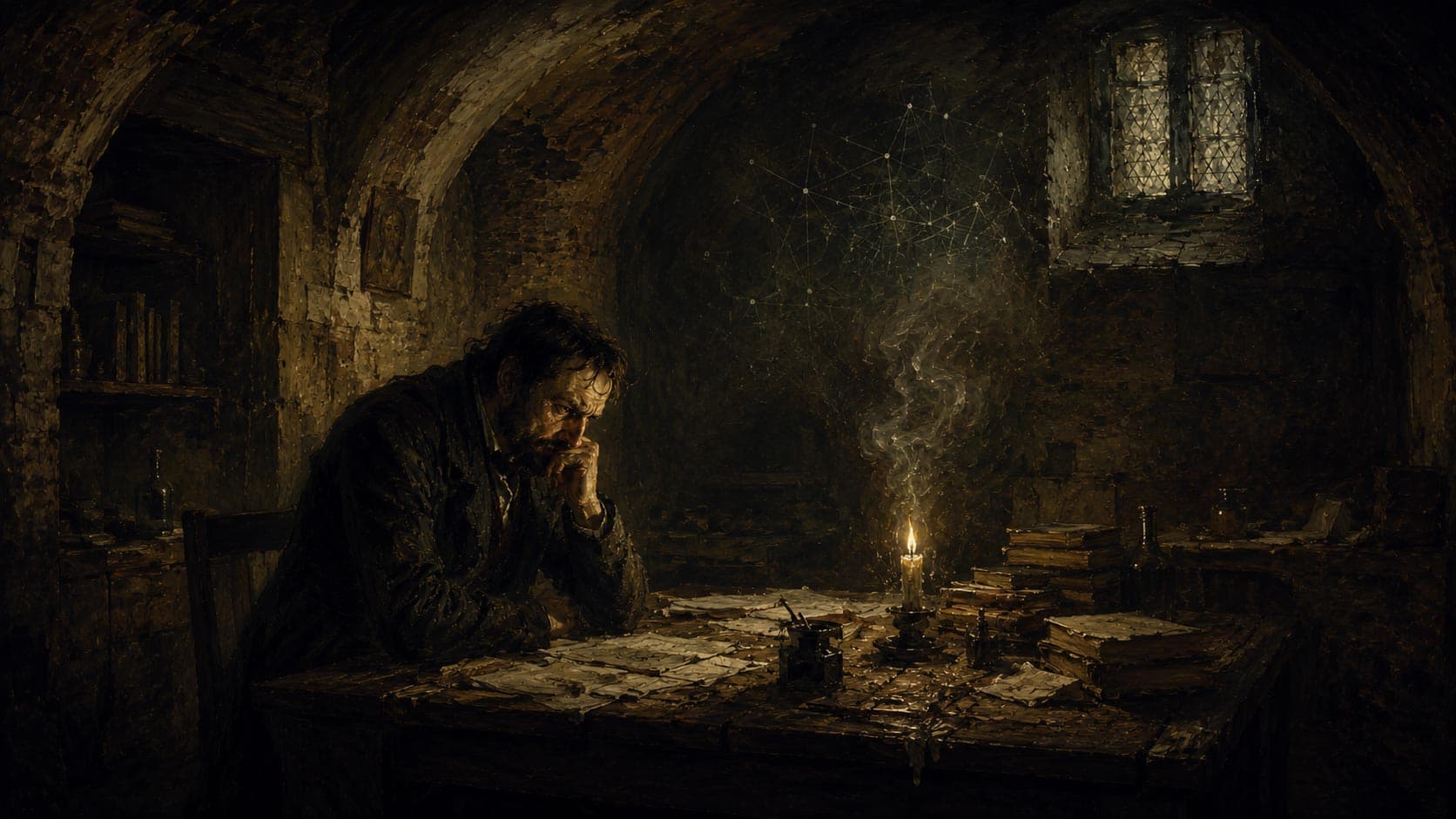
Was Dostoyevsky writing about AI back in 1864?
Not literally, but he was certainly imagining a future in which decisions are made for us, challenges are solved perfectly, and creative endeavors are executed with flawless technical accuracy.
In such a world, one naturally wonders what it would be like to have choice all but removed from daily life. Given our nature, could we still be happy and find meaning in a world governed by perfect rationality?
As AI becomes more capable, this scenario may not be so far-fetched. It may not remove choice completely, but it will almost certainly make giving it up easier.
You can read the full excerpt from Notes from Underground below:
You are confident that then man will cease from INTENTIONAL error and will, so to say, be compelled not to want to set his will against his normal interests. That is not all; then, you say, science itself will teach man (though to my mind it's a superfluous luxury) that he never has really had any caprice or will of his own, and that he himself is something of the nature of a piano-key or the stop of an organ, and that there are, besides, things called the laws of nature; so that everything he does is not done by his willing it, but is done of itself, by the laws of nature. Consequently we have only to discover these laws of nature, and man will no longer have to answer for his actions and life will become exceedingly easy for him. All human actions will then, of course, be tabulated according to these laws, mathematically, like tables of logarithms up to 108,000, and entered in an index; or, better still, there would be published certain edifying works of the nature of encyclopaedic lexicons, in which everything will be so clearly calculated and explained that there will be no more incidents or adventures in the world.
Then--this is all what you say--new economic relations will be established, all ready-made and worked out with mathematical exactitude, so that every possible question will vanish in the twinkling of an eye, simply because every possible answer to it will be provided. Then the "Palace of Crystal" will be built. Then ... In fact, those will be halcyon days. Of course there is no guaranteeing (this is my comment) that it will not be, for instance, frightfully dull then (for what will one have to do when everything will be calculated and tabulated), but on the other hand everything will be extraordinarily rational. Of course boredom may lead you to anything. It is boredom sets one sticking golden pins into people, but all that would not matter. What is bad (this is my comment again) is that I dare say people will be thankful for the gold pins then. Man is stupid, you know, phenomenally stupid; or rather he is not at all stupid, but he is so ungrateful that you could not find another like him in all creation. I, for instance, would not be in the least surprised if all of a sudden, A PROPOS of nothing, in the midst of general prosperity a gentleman with an ignoble, or rather with a reactionary and ironical, countenance were to arise and, putting his arms akimbo, say to us all: "I say, gentleman, hadn't we better kick over the whole show and scatter rationalism to the winds, simply to send these logarithms to the devil, and to enable us to live once more at our own sweet foolish will!" That again would not matter, but what is annoying is that he would be sure to find followers--such is the nature of man. And all that for the most foolish reason, which, one would think, was hardly worth mentioning: that is, that man everywhere and at all times, whoever he may be, has preferred to act as he chose and not in the least as his reason and advantage dictated. And one may choose what is contrary to one's own interests, and sometimes one POSITIVELY OUGHT (that is my idea). One's own free unfettered choice, one's own caprice, however wild it may be, one's own fancy worked up at times to frenzy--is that very "most advantageous advantage" which we have overlooked, which comes under no classification and against which all systems and theories are continually being shattered to atoms. And how do these wiseacres know that man wants a normal, a virtuous choice? What has made them conceive that man must want a rationally advantageous choice? What man wants is simply INDEPENDENT choice, whatever that independence may cost and wherever it may lead. And choice, of course, the devil only knows what choice.
— Fyodor Dostoyevsky, Notes from Underground (1864), trans. Constance Garnett